
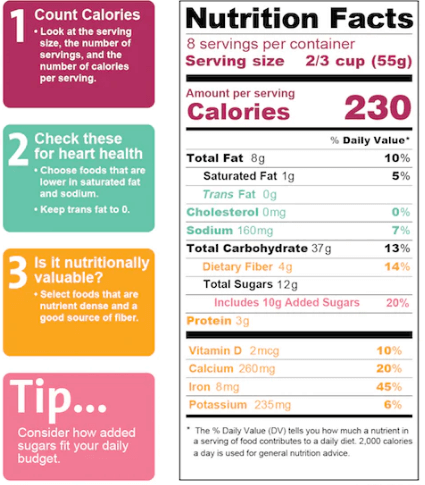
 When it comes to grocery shopping, it can be easy to get caught up in all the hype surrounding different brands and their health claims. However, it's important to remember that manufacturers are often more concerned with selling their products than with the health of their consumers. One way to cut through this noise is to learn how to read food labels, so you can make informed decisions about what you're putting into your body.
The first thing to be aware of when reading a food label is the serving size. All the other specifications, such as calories, fat, and sodium, are based on this serving size. So, if a product has a very small serving size, it may appear to be healthier than it really is. For example, a cereal that has only 1-2 grams of fat per serving may seem like a great option, but if you're eating 3-4 servings at a time, you could be consuming 8-10 grams of fat per serving.
Another important aspect of food labels is the calorie content. Many packaged products will list the calories per serving, but it's important to remember that this is only for the serving size, not for the entire package. So, if you're eating multiple servings at a time, you'll need to multiply the calorie content by the number of servings you're consuming.
Carbohydrates, fats, and proteins are also listed on food labels, usually in grams. For example, if a product has 5 grams of protein per serving, that would equal 20 calories (1 gram of protein = 4 calories). It's important to note that 1 gram of carbohydrates is also equal to 4 calories, and 1 gram of fat is equal to 9 calories.
Sodium is another important aspect of food labels that many people overlook. Many packaged products are high in sodium, which can lead to water retention and hypertension in some cases. Be aware of products with single serving sizes of sodium that are 300 milligrams or more. The recommended daily allowance (RDA) of sodium is 2400 milligrams per day, so it's easy to exceed this limit if you're not careful.
The ingredients listed on a food label are also important to pay attention to. They are listed in order of weight per serving, so the first ingredient is the most prevalent. For example, if a product lists high-fructose corn syrup as the first ingredient, it's likely a high-sugar, high-carbohydrate food. In this case, it's important to also check the sugar content on the label, and make sure the serving is less than 20 grams.
The fat content of food is usually broken down into total fat and saturated fat. Saturated fat, which is the fat from animal products, is something you should aim to avoid. Good sources of fats include olive oil, peanut butter, avocados, and almonds (not almond butter).
Finally, it's important to remember that manufacturers often use different names for fats and sugars on their labels. For example, "triglycerides" and "lard" are both types of fat, and "fructose" and "corn syrup" are both types of sugar. By understanding these terms, you'll be better equipped to make informed decisions about what you're buying.
In conclusion, don't be fooled by all the manufacturer hype out there. Just because a product is labeled "low-fat," "low-sodium," or "fat-free" doesn't mean it's good for you. By learning how to read food labels, you'll be able to make more informed decisions about what you're putting into your body, and avoid unwanted pounds. Remember, you still need to burn more calories than you take in to lose body fat.